

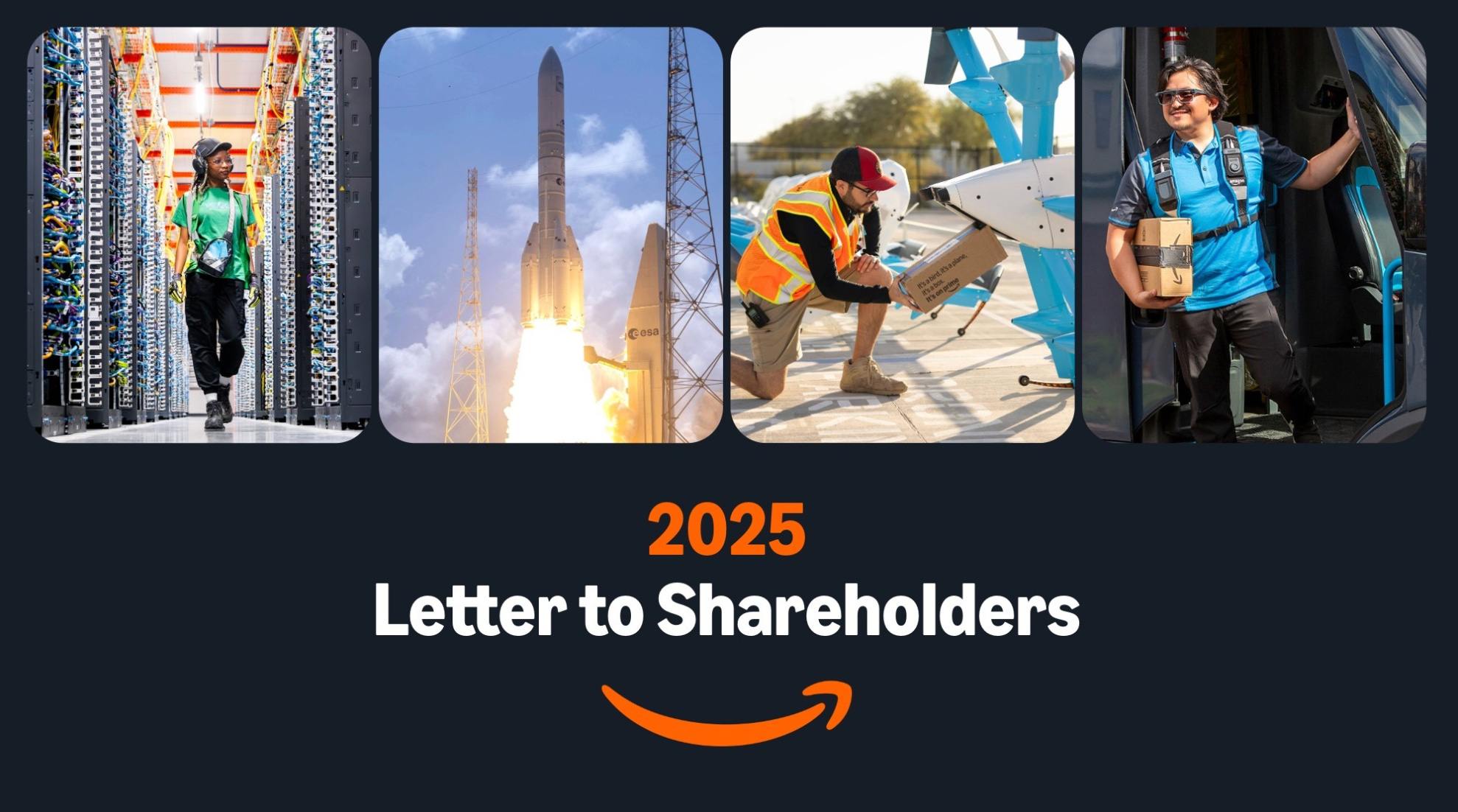
以下是安迪·贾西(Andy Jassy)2026年致股东信的英中对照版:
Dear Shareholders:
亲爱的股东们:
When I graduated from college, I wanted to be a sportscaster. After sending my resume reel to many small markets around the U.S., and only getting two nibbles, I settled on doing sports production at a major network. To make extra money, I also coached my former high school soccer team, and worked at a retail golf store. Six months later, a college classmate convinced me to interview at the consumer products company where he worked, and I spent three years as a Product Manager there. I left that job to try some of my own businesses. After deciding these businesses weren’t my calling, I tried short stints in sales and investment banking, before going back to graduate school and ending up at Amazon three days after my last final exam in May 1997.
当我大学毕业时,我想成为一名体育播音员。在向全美许多小市场投递了样片却只得到两个意向后,我决定在一家大型网络公司从事体育节目制作。为了多挣点钱,我还执教过我母校的高中足球队,并在一家高尔夫零售店工作。六个月后,一位大学同学说服我面试他所在的消费品公司,我在那里做了三年的产品经理。之后我离职尝试创业,在意识到那些生意并非我的使命后,我又短暂尝试过销售和投资银行业务,最后重返研究生院深造,并在 1997 年 5 月最后一场期末考试结束三天后来到了亚马逊。
Not exactly a straight line.
这显然不是一条直线。
AWS followed lots of squiggly lines, too. The original vision included storage, compute, payments, and human intelligence. Some of those (e.g. storage and compute) became lynchpins in AWS. Others didn’t succeed. We didn’t initially plan a database service; and when we built one, our first attempt failed to get traction. We went back to the drawing board and built new relational and non-relational database services, which have resonated well and become core to millions of AWS applications. When we launched EC2 (our compute service), it was a single instance type in one availability zone, Linux-only, with no auto-scaling, load balancing, block storage, or private networking. Over time, we added those capabilities and hundreds more services. AWS was initially attractive to start-ups (companies like DoorDash, Dropbox, Pinterest, Slack, and Stripe were among many that built their businesses on AWS). Pundits said enterprises and governments would never use cloud or AWS for anything substantive. In 2008, Netflix decided to move all of its applications to AWS, then came big commitments from GE, Intuit, and others—and eventually the CIA chose AWS as their partner to build their classified cloud. Growth came fast and furious, and as it accelerated, so too did our capital expenditures (“capex”) with dilutive impact on free cash flow (“FCF”). At our 2014 AWS operating plan review, the discussion started with a senior leader at the company musing, “Tell me again why we’re doing this business?”
AWS(亚马逊云服务)的发展也经历了许多弯曲的线条。最初的愿景包括存储、计算、支付和人类智能。其中一些(如存储和计算)成为了 AWS 的支柱,而另一些则没有成功。我们最初并没打算做数据库服务;当我们真正开始做时,第一次尝试并没能获得市场认可。于是我们推倒重来,构建了新的关系型和非关系型数据库服务,它们引起了强烈共鸣,并成为数百万 AWS 应用程序的核心。当我们推出 EC2(计算服务)时,它只是一个可用区内的一种实例类型,仅限 Linux 系统,没有自动缩放、负载均衡、块存储或私有网络。随着时间的推移,我们增加了这些功能以及数百种其他服务。AWS 最初吸引的是初创公司(如 DoorDash、Dropbox、Pinterest、Slack 和 Stripe 等,许多公司都建立在 AWS 之上)。当时专家们断言,企业和政府永远不会在任何实质性事务中使用云或 AWS。2008 年,Netflix 决定将其所有应用程序迁移到 AWS,随后通用电气(GE)、Intuit 等公司也做出了重大承诺——最终,CIA 选择 AWS 作为合作伙伴来构建其机密云。增长突飞猛进,随着增长的加速,我们的资本支出(Capex)也随之增加,这对自由现金流(FCF)产生了稀释影响。在 2014 年 AWS 的运营计划评审会上,讨论甚至以公司一位资深领导的沉思开始:“再告诉我一次,我们为什么要在这个业务上耗着?”
AWS has worked out well for Amazon, but a straight line? Not really.
AWS 为亚马逊带来了丰厚回报,但它是一条直线吗?真不是。
There’s a band I like from New Zealand called “The Beths,” who’ve written several excellent records, with thought-provoking lyrics. I eagerly await their new releases, and when their latest album dropped last summer titled “Straight Line Was a Lie,” it made me think about how prescient that expression is. Most long-term endeavors do not follow a linear straight line, up and to the right. Progress jumps around; it’ll zig up, then sometimes stall, or zag down, or force you back to the starting line. Sometimes, it feels like you’re running in circles. But, the path is rarely straight.
我喜欢一支来自新西兰的乐队叫“The Beths”,他们写过几张非常出色的唱片,歌词发人深省。我热切期待他们的新作,当他们去年夏天发布名为《直线是个谎言》(Straight Line Was a Lie)的新专辑时,这让我联想到这个表达是多么具有预见性。大多数长期的事业都不会遵循向上向右的线性增长。进步是跳跃式的;它会向上波动,有时会停滞,或者向下曲折,甚至迫使你回到起点。有时,你会觉得自己在原地打转。但是,路径很少是直的。
That’s because the world is complex, and new technology, business model invention, competitors, global issues, or people and cultural shifts can come into play. We’re in the middle of some of the biggest inflections of our lifetime (e.g. AI, robotics, space industrialization, geopolitical and military conflict). And, just as proficient golfers need to be skilled across driving, approach shots, chipping, and putting, durable companies must be adept at managing different elements of inflections. I’ll share some of our lessons below and why we’re bullish on what’s ahead for Amazon.
这是因为世界是复杂的,新技术、商业模式的创新、竞争对手、全球性问题,或是人的因素和文化转型都会产生影响。我们正处于一生中最大的几个转折点之中(例如 AI、机器人、太空工业化、地缘政治和军事冲突)。正如优秀的职业高尔夫球手需要在开球、进场、切球和推球方面都表现出色一样,持久的企业必须擅长处理转折点中的不同要素。我将在下文中分享我们的一些教训,以及为什么我们看好亚马逊的前景。
Wherever possible, invent the next inflections. We try to anticipate what will make customers’ lives easier and better every day, and invent the next inflection. Historically, we’ve successfully done so in areas like Retail, Logistics, AWS, Ads, Kindle, Alexa, and Pharmacy. There are too many new efforts in flight to mention them all, but will mention a few.
只要可能,就创造下一个转折点。 我们努力预见什么能让客户的生活每天变得更轻松、更好,并创造下一个转折点。历史上,我们在零售、物流、AWS、广告、Kindle、Alexa 和医药领域成功做到了这一点。正在推进的新项目太多,无法一一列举,这里提几个:
First, despite many improvements over the years, customers always want lower costs and faster delivery speed. While we continue to work on productivity and inventory levels, robotics provides a step-level change for how we can deliver faster, reduce the cost of carrying more selection, and automate movements that cause strains and injuries to our teammates. Accelerated by acquiring Kiva in 2012, and investing in numerous robotics initiatives the last 14 years, we now have over one million robots operating in fulfillment centers helping with stowing, picking, sorting, and intra-facility transport. And, we’ve done this while continuing to be one of the largest job creators in the country. While the above progress is substantial, we’re still in the early stages of how we’ll leverage robotics. Expect us to keep innovating on form factors, use case diversity, agility, grasping, and intelligence. And, wherever we can leverage our scale and real-time feedback loop from so many robots in our fulfillment network to build robotics solutions for other industrial and consumer customers, we’ll explore doing so.
首先,尽管多年来已有许多改进,但客户始终希望更低的成本和更快的配送。虽然我们继续致力于提高生产力和库存水平,但机器人技术为我们提高配送速度、降低持有更多选品所需的成本,以及实现自动化搬运(从而减轻员工的劳损和受伤风险)带来了阶段性的变革。自 2012 年收购 Kiva 以来,再加上过去 14 年在众多机器人项目上的投入,我们现在有超过一百万台机器人在物流中心运作,协助入库、拣选、分拣和场内运输。而且,我们在做到这一点的同时,继续成为该国最大的就业创造者之一。虽然上述进展是实质性的,但我们利用机器人技术仍处于早期阶段。期待我们在形态设计、用例多样性、灵活性、抓取和智能方面持续创新。只要我们可以利用物流网络中海量机器人的规模和实时反馈循环,为其他工业和消费客户构建机器人解决方案,我们就会去探索。
Second, we understand that rural customers are often de-prioritized by logistics and telecom providers because remote communities are more expensive to serve. While other companies have been backing away from these customers, we’ve been running to them. We’ve committed over $4 billion to expand our rural delivery network. Customer response has been overwhelmingly positive, with the average number of monthly Same-Day customers in rural areas nearly doubling in 2025 compared to the prior year. Once this expansion is complete, our network will be able to deliver over a billion more packages each year to customers living in over 13,000 zip codes spanning 1,200,000 square miles.
其次,我们意识到农村地区的客户往往被物流和电信供应商所忽视,因为服务边远社区的成本更高。当其他公司从这些客户身边退缩时,我们正向他们奔去。我们已投入超过 40 亿美元来扩大农村配送网络。客户反应极度积极,2025 年农村地区每月使用“当日达”的客户平均数量比前一年翻了近一倍。一旦扩张完成,我们的网络每年将能为居住在跨越 120 万平方英里、超过 13,000 个邮编区域的客户多配送 10 亿件包裹。
We’re also trying to close the digital divide for rural communities. There are billions of people on the planet who lack high-speed internet access, and millions of businesses, governments, and other organizations operating in places without reliable connectivity. If you don’t have broadband connectivity, you can’t engage in many of the digital activities (e.g. education, business, information retrieval, shopping, entertainment, etc.) that people take for granted in metropolitan locations. Over the last seven years, we’ve built a low Earth orbit satellite network (Amazon Leo) and put more than 200 satellites into space (which is the third-largest low Earth orbit network operating today). With a few thousand more satellites launching in the coming years, the constellation is expanding rapidly. Apart from enabling this connectivity, Leo will offer three unique benefits. First, the performance will be stronger (about six to eight times better on uplink, and two times better on downlink) than what customers have access to now. Second, this performance will come at a lower cost than alternatives. And third, Leo will seamlessly integrate with AWS to enable enterprises and governments to move data back and forth for storage, analytics, and AI.
我们还试图缩小农村社区的数字鸿沟。地球上有数十亿人缺乏高速互联网接入,数百万企业、政府和其他组织在缺乏可靠连接的地方运作。如果没有宽带连接,你就无法参与许多数字活动(如教育、商业、信息获取、购物、娱乐等),而大都市的人们对此习以为常。在过去的七年里,我们构建了一个低地轨道卫星网络(Amazon Leo),并将 200 多颗卫星送入太空(这是目前运行中的第三大低地轨道网络)。随着未来几年数千颗卫星的发射,星座规模正在迅速扩大。除了实现连接,Leo 还将提供三个独特的优势:第一,性能更强(上行快约 6-8 倍,下行快 2 倍);第二,成本低于替代方案;第三,Leo 将与 AWS 无缝整合,使企业和政府能够来回传输数据以进行存储、分析和 AI 运算。
While Amazon Leo is officially scheduled to launch in mid-2026, we already have meaningful revenue commitments from enterprises and governments. Most recently, Delta Airlines, the highest grossing airline in the world, has announced it’s chosen Amazon Leo for its future Wi-Fi, and will begin with 500 planes in 2028. They join other Leo customers like JetBlue, AT&T, Vodafone, DIRECTV Latin America, Australia’s National Broadband Network, NASA, and others.
虽然 Amazon Leo 正式定于 2026 年中期推出,但我们已经获得了来自企业和政府的显著收入承诺。最近,全球收入最高的航空公司达美航空(Delta Airlines)宣布选择 Amazon Leo 作为其未来的 Wi-Fi 方案,并将于 2028 年从 500 架飞机开始实施。他们与 JetBlue、AT&T、沃达丰、DIRECTV 拉美公司、澳大利亚国家宽带网络、NASA 等客户共同成为了 Leo 的拥趸。
Amazon could be successful for a long time without investing this way in robotics, faster rural delivery, and broadband connectivity for underserved customers and geographies. But, we believe we can invent ways to change what’s possible for customers, are hungry to do so, and are confident these investments will yield meaningful growth and return on invested capital (“ROIC”) for the company.
亚马逊即使不如此投入机器人、农村配送和宽带连接,也可能成功很长时间。但我们相信,我们可以通过发明来改变客户的可能性,我们渴望这样做,并坚信这些投资将为公司带来显著的增长和资本回报率(ROIC)。
Be willing to pursue parallel paths when it’s unclear what’ll best drive the desired trajectory (2 > 0). When I was a kid, I used to go to New York Rangers games with my Dad. I loved hockey, and it was high quality time together. I looked up to my Dad (still do), and hung on his every word. One game, my Dad noticed that one of the Rangers’ defensemen, Dallas Smith, had gone missing from the bench, and stood up and exclaimed “where’s Dallas?” to which a nearby fan said, “in Texas, moron.”
当不确定哪条路最能推动目标轨迹时,要愿意追求平行路径 (2 > 0)。 小时候,我常和父亲去看纽约游骑兵队的比赛。我热爱冰球,那是我们高质量的共处时光。我一直仰慕父亲,听从他的每一句话。有一场比赛,我父亲注意到游骑兵队的一名后卫达拉斯·史密斯(Dallas Smith)从替补席上消失了,他站起来惊呼:“达拉斯在哪儿?”旁边的一位球迷说:“在德克萨斯州(Dallas 也是德州地名),白痴。”
So yes, it’s fairly obvious 2 is greater than zero. But too often, companies focus on what looks most tidy instead of ensuring they have enough efforts in play to achieve an important outcome. Let’s go back to fast delivery in our retail business. We know how much customers crave it, and we see higher order completion rates when delivery promises are faster. Just three years ago, two-day delivery was the gold standard. We pushed that bar to one day, and have been working tirelessly to make it same day.
是的,显然 2 大于 0。但公司往往过于关注那些看起来最整洁的路径,而不是确保有足够的尝试来达成重要的结果。回到我们零售业务的快速配送。我们知道客户多么渴望它,当配送承诺更快时,订单完成率更高。就在三年前,两天送达还是金科玉律。我们将其推进到了一天,并一直不知疲倦地追求当日达。
We’ve invented a new, more streamlined fulfillment center format called Same Day Fulfillment Centers (“SSDs”). We’ve built over 85 SSDs across the U.S. that carry our top 90,000 SKUs, and have enabled us to deliver more than 500 million same day units in 2026 thus far. At the same time, we’ve continued to pursue Prime Air, our drone delivery service. Prime Air now has a design that’ll scale, plans to serve communities with 30 million customers by year-end, and expects to deliver half a billion packages by the end of this decade (with an aim to deliver inside 30 minutes). And, over the last year, starting in India and the UAE, we’ve been working on Amazon Now, ultra-fast delivery on thousands of items within 20 minutes. Customers love this service. In India, where we have more than 360 micro-fulfillment centers (and growing rapidly), Amazon Now orders are increasing 25% month-over-month, with Prime members tripling their shopping frequency once they start using it. We’re starting to expand Amazon Now in the U.S. and Europe, too.
我们发明了一种名为“当日达物流中心”(SSD)的更精简的物流中心模式。我们在美国建立了超过 85 个 SSD,存储最热门的 9 万个 SKU,这使我们在 2026 年至今已配送了超过 5 亿件当日达商品。同时,我们继续推进 Prime Air 无人机配送服务。Prime Air 现在拥有了可以规模化的设计,计划在年底前服务覆盖 3000 万客户的社区,并期望在本十年末配送 5 亿个包裹(目标是 30 分钟内送达)。此外,在过去的一年里,从印度和阿联酋开始,我们一直在推进 Amazon Now,即数千件商品在 20 分钟内超高速送达。客户非常喜欢这项服务。在印度,我们拥有超过 360 个微型配送中心(且增长迅速),Amazon Now 的订单每月增长 25%,Prime 会员一旦开始使用,其购物频率就会翻三倍。我们也开始在美国和欧洲扩展 Amazon Now。
Some companies may have decided to pursue only one of these efforts, arguing for weeks or months which one, all the while pursuing none. A reasonable argument could have been made that just delivering same day would have been enough (“get that done and worry about the other ideas in the future”). But, building an autonomous delivery drone that can deliver millions of items in 30 minutes doesn’t take a year. It’s a multi-year invention cycle. And, ultra-fast delivery from micro-fulfillment centers is already possible and going to happen with or without us. So, we need to have multiple parallel paths to drive this next delivery speed shift. And, we’ve found that they’re complementary. The drones will use SSDs as a building block from which to gather selection and launch. And, while Amazon Now will deliver thousands of items within 20 minutes by leveraging micro-fulfillment centers, Prime Air will deliver a much larger selection of items inside a half hour. They will all serve different needs and drive the inflection better as a group than just having one.
有些公司可能会决定只追求其中一项努力,争论数周或数月哪项更好,结果导致一项都没成。一个合理的论点可能是,只要做到当日达就足够了(“先把那个搞定,以后再操心别的想法”)。但是,构建一架能 30 分钟配送数百万件商品的自动无人机不是一年就能完成的,这是一个多年的研发周期。而且,利用微型配送中心实现超高速配送已经在发生,无论我们是否参与。所以,我们需要多条平行路径来推动下一次配送速度的变革。我们发现它们是互补的:无人机将以 SSD 为基础获取选品并起飞;虽然 Amazon Now 通过微型配送中心在 20 分钟内送达数千件商品,但 Prime Air 能在半小时内送达更广泛的商品。它们满足不同的需求,作为一个整体比单一路径更能推动转折。
Another example of our pursuing multiple paths is Grocery. We started 20 years ago by adding non-perishables (items you’d find in the middle aisles of grocery stores like consumables, canned goods, beauty, etc.). Customers loved the convenience of buying these items online and having them delivered quickly. Unsurprisingly, they asked for broader grocery coverage, with perishables high on their list. We embarked on several bets to try to find the right economic solution for customers and Amazon. We bought Whole Foods Market (“WFM”) in 2017, the leader in organic grocery. We’ve since launched mainstream physical grocery stores (Amazon Fresh), grocery subscriptions for Prime members, and store-within-a-store concepts (with Amazon offering mainstream brands alongside WFM organic brands). Not all of these experiments have worked, but each one has taught us something important.
追求多条路径的另一个例子是生鲜杂货(Grocery)。我们从 20 年前开始,通过添加非易耗品(超市中间货架的商品,如快消品、罐头、美妆等)起步。客户喜欢在线购买这些商品并快速送达的便利。不出所料,他们要求更广泛的杂货覆盖,生鲜产品名列前茅。我们进行了一系列尝试,试图为客户和亚马逊找到正确的经济解决方案。我们在 2017 年收购了有机食品领导者 Whole Foods Market(WFM)。随后推出了主流物理杂货店(Amazon Fresh)、针对 Prime 会员的杂货订阅,以及“店中店”概念。并非所有这些实验都奏效了,但每一次都教会了我们重要的事情。
What’s emerged is a clearer picture of what customers want. Our non-perishables grocery business continues to grow quickly. WFM continues to accelerate, with over 550 stores, 100 more coming in the next few years, and an additional smaller format (Daily Shop) serving quick, frequent grocery missions in city neighborhoods that’s off to a great start. And, a big breakthrough has been adding perishables into our Same-Day Delivery network. Bringing fresh groceries (e.g. produce, dairy, meat) together with millions of everyday items in a single, fast order is resonating with customers for the value and convenience it provides. Since introducing perishables into Same-Day Delivery in early 2025, perishables sales have grown by over 40 times, and now make up nine of the top ten most-ordered items for Same-Day Delivery where they’re available. We have Same-Day fresh food delivery in over 2,300 towns and cities across the country. Our grocery business has grown to over $150 billion in gross sales in 2025, making Amazon the second-largest grocer in the U.S.
现在的局面是客户需求图景变得更加清晰。我们的非易耗品业务持续快速增长。WFM 持续加速,拥有超过 550 家门店,未来几年还将增加 100 家,此外还有一种更小型的业态(Daily Shop)专门服务于城市社区快速、高频的购物任务,开局非常顺利。而一个巨大的突破是将生鲜产品纳入我们的“当日达”配送网络。将生鲜(如农产品、乳制品、肉类)与数百万种日常用品整合在一个快速订单中,这种价值和便利性引起了客户的强烈共鸣。自 2025 年初在当日达中引入生鲜以来,生鲜销售额增长了 40 多倍,目前在已开通服务的地区,生鲜产品占当日达订单前 10 名中的 9 个。我们在全国 2300 多个城镇提供当日达生鲜配送。2025 年我们的杂货业务销售额已增长至 1500 亿美元以上,使亚马逊成为美国第二大杂货商。
If there’s an obvious path to changing your trajectory, take it and run. But, most new jumps forward aren’t like that. There’s invention and experimentation required, and pursuing multiple paths gives you the best chance to find it.
如果有显而易见的路径可以改变你的轨迹,那就选它并全力奔跑。但大多数新的飞跃并非如此,需要创新和实验,追求多条路径能给你找到答案的最佳机会。
When you identify disproportionate inflections, bet big. Choosing which inflections are truly seminal versus “just interesting” requires judgment. Reasonable people can disagree. But, if you believe you’ve found one of these disproportionate shifts, you want to invest as aggressively as you responsibly can. This will create investment spikes that will invite scrutiny, but the game-changers don’t typically accommodate smoother investment horizons.
当你识别出不成比例的转折点时,重注赌赢。 选择哪些转折点是真正具有开创性的,哪些只是“有意思的”,需要判断力。理智的人也会有分歧。但是,如果你相信你发现了一个这种级别的转变,你就需要尽一切可能负责任地、激进地进行投资。这会导致投资激增并招致审查,但改变游戏规则的机会通常不会迁就平滑的投资曲线。
One of these seminal shifts is AI. Every customer experience will be reinvented by AI, and there will be a slew of new experiences only possible because of AI. I’ve followed the public debate on whether this technology is over-hyped, whether we’re in “a bubble,” and if the margins and ROIC will be appealing. My strong conviction, at least for Amazon, is that the answers are no, no, and yes. Here are some truths that are hard to debate.
其中一个开创性的转变是 AI。 每一个客户体验都将被 AI 重塑,也将诞生大量仅靠 AI 才能实现的全新体验。我一直在关注公众关于这项技术是否被过度炒作、我们是否处于“泡沫”中,以及利润率和资本回报率是否具有吸引力的争论。我的坚定信念是(至少对亚马逊而言):答案分别是:不是、不是、以及是。以下是一些难以反驳的事实:
1/ We have never seen a technology more quickly adopted than AI. When ChatGPT launched in November 2022, it reached 100 million users in two months—four times faster than TikTok and 15 times faster than Instagram (ChatGPT already has over 900 million weekly active users). Both OpenAI and Anthropic have revenue run rates reportedly approaching $30 billion. These are breathtaking numbers for companies this soon after their commercial launches. When Edison opened his first commercial power station in 1882, most people understood it as a better way to light a room. What they couldn’t see was that electricity would eventually reorganize every factory, home, and industry on Earth. AI may have comparable impact. The difference is that electricity took 40 years to get where it was going. AI appears to be moving ten times faster.
1/ 我们从未见过比 AI 普及更快的技术。当 ChatGPT 于 2022 年 11 月推出时,它在两个月内达到了 1 亿用户——比 TikTok 快 4 倍,比 Instagram 快 15 倍(ChatGPT 现在的周活跃用户已超过 9 亿)。据报道,OpenAI 和 Anthropic 的收入运行率已接近 300 亿美元。对于商业化推出不久的公司来说,这些数字令人惊叹。1882 年爱迪生开设第一个商业发电站时,大多数人认为这只是照亮房间的好办法。他们看不到电力最终将重组地球上的每一家工厂、家庭和工业。AI 可能具有相当的影响力,区别在于电力花了 40 年才达到目标,而 AI 的速度似乎快了 10 倍。
2/ Amazon is smack in the middle of this land rush, and companies are choosing AWS for AI. Three years after AWS launched commercially, it had a $58 million revenue run rate. Three years into this AI wave, AWS’s AI revenue run rate is over $15 billion in Q1 2026 (nearly 260 times larger than AWS at that same point)—and ascending rapidly.
2/ 亚马逊正处于这场“圈地运动”的核心,企业正在选择 AWS 进行 AI 研发。AWS 商业化推出三年后,其收入运行率为 5800 万美元。而在 AI 浪潮爆发三年后的 2026 年第一季度,AWS 的 AI 收入运行率已超过 150 亿美元(是同期 AWS 规模的近 260 倍),且正在迅速攀升。
Customers are choosing AWS for AI for a few reasons. First, we have broader capabilities than others, with compelling offerings for model-building (SageMaker), high-performance inference with leading selection of frontier models (Bedrock), lower-cost inference (on our custom silicon, Trainium), agent-building (Strands), scalable and secure agent environments (AgentCore), and turnkey agents for coding, software migrations, and most tasks knowledge workers use in their daily routines (Kiro, Transform, and Quick). Second, as customers expand their use of AI, they want their inference to reside near their other applications and data (for latency reasons), and much more of it resides in AWS than anywhere else. Third, as customers expand their AI usage, they consume a lot of additional non-AI services, where AWS also has the broadest and most capable offerings. And fourth, AWS has the strongest security and operational performance of any AI and infrastructure provider. We spend a lot of time listening to customers, and they continue to remark about AWS’s advantaged performance as they increasingly move their AI to AWS.
客户选择 AWS 进行 AI 研发有几个原因。首先,我们拥有比别人更广泛的能力,从模型构建(SageMaker)、高性能推理(Bedrock)、低成本推理(自研芯片 Trainium)、Agent 构建(Strands)到安全环境(AgentCore),以及用于编码和软件迁移的一站式 Agent(Kiro、Transform 和 Quick)。其次,随着 AI 使用的扩展,客户希望推理靠近其现有的应用和数据以降低延迟,而存储在 AWS 上的数据比任何地方都多。第三,当客户扩展其 AI 使用时,他们会消耗大量的非 AI 服务,而 AWS 在这方面也拥有最广泛和最强大的产品。第四,AWS 拥有任何 AI 和基础设施供应商中最强的安全性和运营性能。
3/ AWS could be growing even faster. AWS added 3.9 gigawatts (“GW”) of new power capacity in 2025, expects to double total power capacity by the end of 2027, and is monetizing that capacity as fast as it’s installed. In Q4 2025, AWS reported 24% YoY growth with a $142 billion dollar revenue run rate. That’s a lot of absolute growth. And yet, we still have capacity constraints that yield unserved demand. [As an aside, two large AWS customers have already asked if they could buy all of our Graviton instance capacity in 2026 (Graviton is our widely-adopted custom CPU chip)—we can’t agree to these requests given other customers’ needs, but it gives you an idea of the demand.]
3/ AWS 本可以增长得更快。AWS 在 2025 年新增了 3.9 吉瓦(GW)的电力容量,预计到 2027 年底总容量将翻倍,并且正在尽可能快地将这些容量变现。在 2025 年第四季度,AWS 报告了 24% 的同比增长,年收入运行率达到 1420 亿美元。即便如此,我们仍面临产能限制,无法完全满足需求。[顺便提一下,两家大型 AWS 客户已经询问是否可以在 2026 年买下我们所有的 Graviton 实例容量——由于其他客户的需求,我们无法答应,但这让你对需求有了直观认知。]
4/ Our chips business is on fire, changes the economics for AWS, and will be much larger than most think. Virtually all AI thus far has been done on NVIDIA chips, but a new shift has started. We have a strong partnership with NVIDIA, will always have customers who choose to run NVIDIA, and we will continue to make AWS the best place to run NVIDIA. However, customers want better price-performance. We’ve seen this movie before. In the CPU space, virtually all of the workloads ran on Intel chips until we invented Graviton in 2018. Graviton, which has up to 40% better price-performance than other x86 processors, is now used expansively by 98% of the top 1,000 EC2 customers. The same story arc is unfolding in AI. Our second version of our custom AI silicon (Trainium2) had about 30% better price-performance than comparable GPUs, and has largely sold out. Trainium3, which just started shipping at the start of 2026 and is 30-40% more price-performant than Trainium2, is nearly fully-subscribed. A significant chunk of Trainium4, which is still about 18 months from broad availability, has already been reserved. And, Amazon Bedrock, AWS’s primary (and very fast-growing) inference service, runs most of its inference on Trainium. Demand for Trainium is booming.
4/ 我们的芯片业务火爆,改变了 AWS 的经济效益,且规模将远超大多数人的想象。到目前为止,几乎所有的 AI 运算都是在 NVIDIA 芯片上完成的,但转变已经开始。我们与 NVIDIA 有着紧密的伙伴关系,但客户想要更好的性价比。我们在 CPU 领域见过同样的戏码:在 2018 年我们发明 Graviton 之前,几乎所有工作负载都在 Intel 芯片上跑。现在,前 1000 大 EC2 客户中 98% 都在广泛使用 Graviton。同样的剧情正在 AI 领域上演。我们的第二代自研 AI 芯片(Trainium2)性价比比同类 GPU 高约 30%,已基本售罄。2026 年初开始发货的 Trainium3 性能又提升了 30-40%,已几乎被订满。即便距离大规模上市还有 18 个月的 Trainium4,很大一部分也已被预订。此外,AWS 的主要推理服务 Amazon Bedrock 的大部分推理都在 Trainium 上运行。
Having our own hotly demanded AI chip opens up many possibilities, but perhaps none larger than the ability to lower costs for customers and secure better economics for AWS. At scale, we expect Trainium will save us tens of billions of capex dollars per year, and provide several hundred basis points of operating margin advantage versus relying on others’ chips for inference.
拥有自主研发且需求旺盛的 AI 芯片意味着我们能降低客户成本并确保 AWS 更好的经济效益。规模化后,我们预计 Trainium 每年将为我们节省数百亿美元的资本支出,并比依赖他人的推理芯片提供数百个基点的运营利润率优势。
Our annual revenue run rate for our chips business (inclusive of Graviton, Trainium, and Nitro—our EC2 NIC) is now over $20 billion, and growing triple digit percentages YoY. To dimensionalize this versus other chips companies, that run rate is somewhat understated by our currently only monetizing our chips through EC2. If our chips business was a stand-alone business, and sold chips produced this year to AWS and other third parties (as other leading chips companies do), our annual run rate would be ~$50 billion. There’s so much demand for our chips that it’s quite possible we’ll sell racks of them to third parties in the future.
目前我们芯片业务(包括 Graviton、Trainium 和 Nitro)的年收入运行率已超过 200 亿美元,同比增长达到三位数。为了让您对比其他芯片公司:目前这个运行率被低估了,因为我们只通过 EC2 变现。如果我们的芯片业务独立运营并向第三方出售,年收入运行率将接近 500 亿美元。由于需求极其旺盛,未来我们很有可能向第三方出售整机柜芯片。
5/ The way AWS’s cash cycle works is that the faster AWS grows, the more short-term capex we’ll spend. AWS has to lay out cash for land, power, buildings, chips, servers, and networking gear in advance of when we can monetize it (typically 6-24 months before we start billing customers, depending on the component). However, these capex investments fund assets with many-year useful lives (30+ years for datacenters; 5-6 years for chips, servers, and networking gear). The FCF and ROIC for these investments are cumulatively quite attractive a couple years after being in service; however, in times of very high growth (like now), where the capex growth meaningfully outpaces the revenue growth, the early-years FCF is challenged until these initial tranches of capacity are being monetized and revenue growth out-paces capex growth. We’ve been through this cycle with the first big AWS growth wave, and liked the results. We expect to feel similarly about this next wave, with much larger potential downstream revenue and FCF.
5/ AWS 的现金周期规律是:增长越快,短期资本支出越多。我们必须提前 6-24 个月投入现金购买土地、电力、建筑、芯片和服务器,然后才能开始计费。然而,这些投资支持的是长寿命资产(数据中心 30 多年,芯片服务器 5-6 年)。在极高增长期(如现在),早期现金流会面临挑战,直到产能开始变现。我们经历过第一波 AWS 增长浪潮并喜欢那个结果,我们预计这一波也将如此。
6/ We have customer commitments that make our capex investments predictable. We’re not investing approximately $200 billion in capex in 2026 on a hunch. The recent OpenAI commitment (over $100 billion) is an example of this, but there are several other customer agreements completed (and unannounced), or deep in process. Of the AWS capex we expect to spend in 2026, much of which will be monetized in 2027-2028, we already have customer commitments for a substantial portion of it.
6/ 客户承诺让我们的资本支出投资具有可预见性。我们 2026 年投入约 2000 亿美元的资本支出并非凭直觉。最近 OpenAI 超过 1000 亿美元的承诺就是一个例子。2026 年的支出中很大一部分已经有了客户承诺。
We are willing to make large capex investments and endure short-term FCF headwinds for the substantial medium to long-term FCF surplus. AI is a once-in-a-lifetime opportunity where the current growth is unprecedented and the future growth even bigger. AWS has a significant leadership position with the broadest functionality, strongest security and operational performance, largest share of customers and revenue, strong desire from customers to run their AI in AWS, and an opportunity to build what could be a new pillar for Amazon in chips. We’re not going to be conservative in how we play this—we’re investing to be the meaningful leader, and our future business, operating income, and FCF will be much larger because of it.
我们愿意为了中长期的现金流盈余而承受短期的 FCF 压力。AI 是百年一遇的机会,目前的增长是史无前例的。我们不会在策略上保守——我们正在为成为领导者而投资,我们的未来业务、运营利润和现金流将因此变得规模巨大。
Accept going back to the starting line to redirect the trajectory. When you have a product that’s working at scale, one of the hardest decisions to make is to go back to the starting line. It feels like going backwards (because it kind of is). Teams understandably argue that they don’t have time to both run the existing service and reimagine everything anew. But, there are reasons to do so, and AI is making it easier and more imperative to go back to the starting line.
为了重新定位轨迹,接受回到起点。 当你有一个已经规模化的产品时,最难的决定就是回到起点。这感觉像是在倒退。团队会争辩说没时间重构,但 AI 使得回到起点变得既更容易也更紧迫。
For instance, in Amazon Bedrock, as often happens with services that get built rapidly and scale faster than expected, the team realized that it needed a different inference engine than had originally been built. This wasn’t a tweak; it required a completely different architecture. The team was operating a large and fast-growing service, so it wasn’t ideal. Normally, this sort of activity might take a team of 40 people about a year to carefully build. Instead, the Bedrock team spun up a separable group of six very skilled engineers who were excited about starting over and building on our agentic coding service (Kiro), and delivered this new engine (which we call “Mantle”) in 76 days. Mantle has become the backbone of our very successful Bedrock service, which has nearly doubled month-over-month this past March, and processed more tokens in Q1 2026 than all of the tokens processed in the prior years combined.
例如在 Amazon Bedrock,团队意识到需要一个与最初构建完全不同的推理引擎。这不是微调,而是需要完全不同的架构。通常这需要 40 人的团队花一年时间,相反,Bedrock 团队抽调了 6 名顶尖工程师,利用我们的 Agent 编码服务(Kiro),在 76 天内交付了名为“Mantle”的新引擎。Mantle 现已成为 Bedrock 的支柱。
Alexa is another interesting example. With 600 million active endpoints across devices, cars, offices, Fire TV, and Prime Video, Alexa has scale and a very large customer base. But, when transformative technology like generative AI arrives, and you can build a much more intelligent product than you previously had, you have to pursue it—even if it’s disruptive to your team, roadmap, and architecture. The new Alexa+ is so much more capable, useful, and smart than her prior self. But, we had to completely rewire her brain, corresponding intelligence, breadth of knowledge, routing of services and APIs she accesses, and what routines and jobs she could do. The team had to make these changes while also serving the existing large customer base, and execute a roll out that didn’t break all the functionality on which so many customers have come to rely. It’s been worth it. Customers are talking to Alexa twice as much (and for longer durations across a wider breadth of topics), completing purchases on devices three times more, streaming music 25% more, and using smart home functionality 50% more. Alexa is still early in its journey to be the world’s best personal assistant. But, it wouldn’t be on its way again without going back to the start.
Alexa 是另一个有趣的例子。尽管拥有 6 亿个活跃终端,但当生成式 AI 出现时,你必须追求它——哪怕这意味着要颠覆现有的架构。新的 Alexa+ 变得聪明得多,但我们必须彻底重构她的“大脑”。结果是值得的:客户与 Alexa 的对话频率翻倍,在设备上完成购买的频率增长了三倍。如果不回到起点,她就不会重新启航。
If you believe that every customer experience will be reinvented in the coming years by AI, it means even the customer experiences that feel most comfy, and are most broadly adopted, will be reimagined. Take our retail business. We believe that customers will always care deeply about massive selection, low prices, very fast delivery, ease of use, and how they’re treated. Amazon has built a lot of capabilities that position us well to meet these customer needs for years to come. However, it’s not hard to imagine with the emergence of AI, that the interface with which customers want to interact with a retailer could be substantially different over time. The temptation is to just add a little AI to the existing experience. That’s a start. But, the trick for leaders, ourselves included, is how to get organized and convicted about going back to the starting line and reimagining your experiences from a clean sheet of paper, assuming you were building with the new technology available. It’s easier to say than do. But, it’s what we’re doing in all of our consumer experiences. It may take us a while to find experiences better than what we have now, and it may take consumers time to adopt these new experiences. But, history shows the “straight line was a lie.” Everything gets reinvented. And, if you want to be finding that next zig, you need to be willing to go back to first principles.
不要只是在现有体验上加一点 AI。领导者的诀窍在于,要有勇气在一张白纸上假设利用新技术重新构思体验。我们正在对所有的消费者体验进行这种重塑。历史证明,“直线是个谎言”,一切都会被重新发明。如果你想找到下一个转折,你需要回到第一性原理。
Cultivate a culture that can cope with squiggly lines. You may be operating successfully for several years, when an inflection shatters this placidity. Sometimes, teams live in denial that a big change is afoot, as it can be threatening to change course. The historical business landscape is littered with companies that wished away big new inflections to their own detriment (and we have been the beneficiary of a few).
培养一种能应对“弯曲曲线”的文化。 你可能成功运营了多年,直到一个转折点打破平静。有时团队会拒绝承认变革正在发生。历史上充满了因为无视转折点而走向衰落的公司。
Here’s some of what I’ve learned over the past 28 years at Amazon.
以下是过去 28 年我在亚马逊学到的一些教训:
You need to have the right data, mechanisms, and truth-tellers to deeply question what’s changed and should therefore be done.
你需要正确的数据、机制和敢说真话的人,去深度质疑什么已经改变了。
You have to have people and a culture that are comfortable operating with ambiguity as you sort through the new normal.
你必须拥有能够适应模糊性的团队和文化。
You need to invent and experiment like crazy. Many of these experiments will fail, and it might feel like you’re getting nowhere. But, your culture must possess the tenacity to keep at it.
你需要疯狂地发明和实验。许多实验会失败,但你的文化必须具备坚持下去的韧性。
You need to learn constantly. Each attempt you (and others) make provides insight on what customers really want.
你需要不断学习。每一次尝试都能让你洞察客户真正想要什么。
You need to move fast, have teammates that act like true owners, and be scrappy. At Amazon, we talk a lot about operating like the world’s biggest startup. It’s the primary reason we’ve worked to flatten our organization the last year, and we’re pleased with the improved speed of decision-making and delivery.
你需要跑得快,有主人翁精神。我们努力让组织扁平化,我们对决策速度的提升感到满意。
You have to be comfortable potentially over-rotating when pursuing one of these big needle-movers. You may end up investing a little more than needed, but it’s better to capture most of the transformational upside than to miss much of it by cutting it too fine. And then, if you learn something new that requires course correcting, do it quickly. Inflections aren’t usually smooth or calm. They favor the bold and adaptable.
在追求重大机遇时,要敢于“过度投资”。多投一点比错过转型红利要好。转折点偏爱勇敢和适应力强的人。
You have to be adept at both inventing the inflections and recognizing when others have started ones that you should pursue as well. We tend to be first-movers, but have had several big successes where we didn’t enter first. In each of these cases, we haven’t just duplicated what others have done (when we’ve done that, we haven’t succeeded). Rather, we’ve been inspired by new ideas, and invented unique experiences that appeal to our customers. It takes a different type of grit and resolve than when you’re first to an idea.
你必须既能创造转折点,又能识别别人创造的转折点。当我们后来居上时,关键在于不简单复制,而是创造独特的体验。
You have to be willing to reimagine not only every customer experience, but also how you organize and get work done. Challenging conventions that have existed a long time (and worked) is difficult. People sometimes call these “change management” obstacles. That’s true, but in times of transformational tumult, they’re almost like reexamining your faith.
你必须愿意重新想象每一个客户体验,甚至重新审视工作方式。这很难,有时就像在重新审视你的信仰。
And, you have to be able to withstand criticism as you’re making your way through an inflection. We have historically shared that we’re “comfortable being misunderstood for long periods of time.” This resolve is required when you’re inventing in general, but particularly when you’re in the middle of a meaningful change where there’s uncertainty and conflicting opinions.
你必须能经受住批评。我们常说“愿意长期被误解”,在充满不确定的变革中,这种定力是必须的。
Parting thoughts. Amazon had another strong year in 2025.
结语。亚马逊在 2025 年又度过了强劲的一年。
Amazon’s revenue in 2025 grew 12% year-over-year (“YoY”) from $638 billion to $717 billion. By segment, North America revenue increased 10% YoY from $387 billion to $426 billion, International revenue grew 13% YoY from $143 billion to $162 billion, and AWS revenue increased 20% YoY, from $108 billion to $129 billion.
2025 年收入增长 12%,达到 7170 亿美元。AWS 收入增长 20%,达到 1290 亿美元。
Amazon’s operating income in 2025 improved 17% YoY, from $69 billion (an operating margin of 10.8%) to $80 billion (an operating margin of 11.2%).
运营利润增长 17%,达到 800 亿美元(利润率为 11.2%)。
Free Cash Flow decreased from $38 billion to $11 billion, driven primarily by a year-over-year increase of $50.7 billion in purchases of property and equipment, net of proceeds from sales and incentives. This FCF change primarily reflects capex investments in artificial intelligence.
自由现金流降至 110 亿美元,主因是资本支出增加了 500 多亿美元,主要投向 AI。
It’s hard to overstate my optimism for what’s ahead.
我对未来充满乐观,怎么形容都不为过。
Our retail business is now approaching $600 billion in topline, yet roughly 80% of global retail sales still happens in physical stores. That will change.
我们的零售业务接近 6000 亿,但全球 80% 仍在实体店。这会改变。
AWS is at a $142 billion revenue run rate, and yet 85% of global IT spend remains on-premises. This will change.
AWS 年运行率 1420 亿,但全球 85% 的 IT 支出仍在本地。这也会改变。
Our Advertising offerings continue to grow and deliver strong returns for brands, while newer businesses like Prime Video, Pharmacy, and Grocery are providing unique customer experiences, growing robustly, and improving their economics.
广告、Prime Video、医药和杂货业务都在强劲增长并改善经济效益。
We’re on the verge of launching Amazon Leo, just beginning commercial service with Zoox (our autonomous-driving ride-hailing service), and still quite early in what we’ll build in robotics.
我们即将推出 Amazon Leo,Zoox 开始商业化,机器人的应用也才刚刚开始。
Across all of this, AI is not a standalone initiative—it’s a multiplier. It will reshape every customer experience we offer and unlock entirely new ones. We will build many of these ourselves, and continue making AWS the best place for others to do the same.
AI 不是一个独立的举措,它是一个乘法器。它将重塑每一个客户体验。
Progress will not be linear. There will be moments of acceleration and moments where we adjust course. We will experiment, invest disproportionately behind what matters, and pull back when something isn’t working.
进步不会是线性的。会有加速,也会有调整。
This is the environment where Amazon does its best work. We’ve built a culture that thrives in constantly changing circumstances by being inventive, comfortable operating along multiple paths, revisiting first principles, and committing fully to the ideas that can meaningfully improve customers’ lives. As always, we’ll optimize for what matters most to customers and shareholders over the long term.
这正是亚马逊大显身手的环境。我们将始终为客户和股东的长期利益而优化。
Thank you to our teammates for everything you’ve done this past year and for what’s ahead. I look forward to pursuing this amazing adventure together.
感谢我们的队友。我期待共同追求这场奇妙的冒险。
Sincerely,
诚挚地,
Andy Jassy
安迪·贾西
President and Chief Executive Officer
总裁兼首席执行官
Amazon.com, Inc.
亚马逊公司
P.S. As we have always done, our original 1997 Shareholder Letter follows. What’s written there is as true today as it was in 1997.
附:一如既往,我们附上 1997 年最初的致股东信。那里写的内容在今天依然如 1997 年那样真实。